The 50 States of Electric Vehicles: States File NEVI Plans, Integrate EVs into Overall Grid Planning Q3 2025
Raleigh, NC – (October 29, 2025) The NC Clean Energy Technology Center (NCCETC) released its Q3 2025 edition of The 50 States of Electric Vehicles. The quarterly series provides insights on state regulatory and legislative discussions and actions on electric vehicles and charging infrastructure.
The report finds that 33 states, plus DC, took actions related to electric vehicles and charging infrastructure during Q3 2025 (see figure below), with the greatest number of actions relating to rebate and grant programs; rate design for commercial, public, and residential charging; managed charging programs; charging infrastructure planning activities; and public charging station rules.
A total of 146 electric vehicle actions were taken during Q3 2025, in addition to 263 introduced bills that have not yet passed a legislative chamber. The most active states this quarter were Maryland, California, New Jersey, New York, Connecticut, and Michigan, followed by Massachusetts, Hawaii, and Illinois. Action counts include only regulatory activities and legislation that has passed at least one chamber, with all introduced bills available in an appendix to the report.
Q3 2025 State and Utility Action on Electric Vehicles
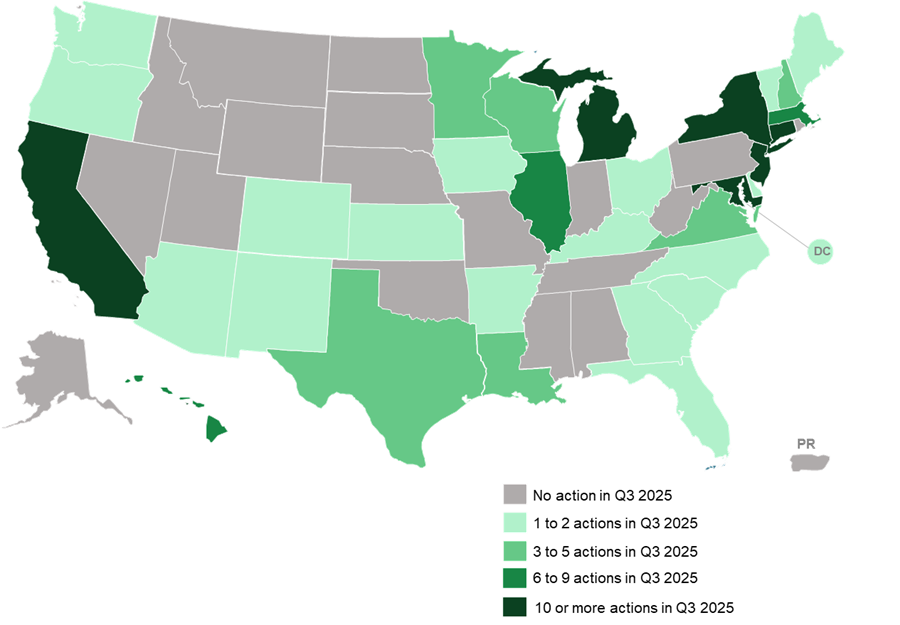
The report discusses three trends in electric vehicle actions taken in Q3 2025: (1) states filing Fiscal Year 2026 NEVI plans, (2) states integrating electric vehicle charging into grid planning efforts, and (3) utilities targeting non-residential customers in electric vehicle programs.
“This quarter, almost forty states filed their annual plans for the National Electric Vehicle Infrastructure Program, aligned with new federal guidance,” noted Cleo Carter, Policy Analyst at NCCETC. “These filings demonstrate states’ transition from the Phase 1 Alternative Fuel Corridor build-out towards Phase 2 discretionary spending.”
The report notes five of the top policy developments of the quarter:
- U.S. Department of Transportation releasing new NEVI guidance;
- Connecticut regulators establishing a medium- and heavy-duty charging program;
- Georgia regulators approving Georgia Power’s vehicle-to-grid pilot;
- Maryland utilities proposing virtual power plant pilots with vehicle-to-grid; and
- Oregon lawmakers passing a bill mandating Vehicle Miles Traveled fees.
“Actors in several states demonstrated the growing importance of accounting for the grid impacts of electric vehicle adoption this quarter,” observed Caitlin Flanagan, Policy Analyst at NCCETC. “Legislators passed multiple bills that require resource and energy planning to incorporate electric vehicle adoption opportunities and their corresponding impact on energy demand, while utilities are increasingly integrating electric vehicle programs into their wider grid planning.”
View the 50 States of Electric Vehicles Q3 2025 Quarterly Report Executive Summary
View and Purchase the 50 States of Electric Vehicles Q3 2025 Quarterly Report
ABOUT THE NC CLEAN ENERGY TECHNOLOGY CENTER
The NC Clean Energy Technology Center, as part of the College of Engineering at North Carolina State University, advances a sustainable energy economy by educating, demonstrating and providing support for clean energy technologies, practices and policies. It serves as a resource for innovative, sustainable energy technologies through technology demonstration, technical assistance, outreach and training. For more information about the Center, visit: http://www.nccleantech.
Media Contact: Shannon Helm, NCCETC, shannon_helm@ncsu.edu