NC Clean Energy Technology Center Launches Policy Tracker to Help States Improve Energy Affordability
Article sections
Raleigh, NC – (June 30, 2026) The N.C. Clean Energy Technology Center (NCCETC) released its inaugural 50 States of Energy Affordability Report. This new, free quarterly series will provide updates on state and utility actions to address rising electricity costs, including utility business model reforms, utility oversight and cost recovery, infrastructure planning and procurement processes, customer cost allocation, and customer programs. The report focuses on replicable and scalable policies that policymakers, regulators, utilities, and other stakeholders can implement right now to address ratepayers’ energy affordability concerns.
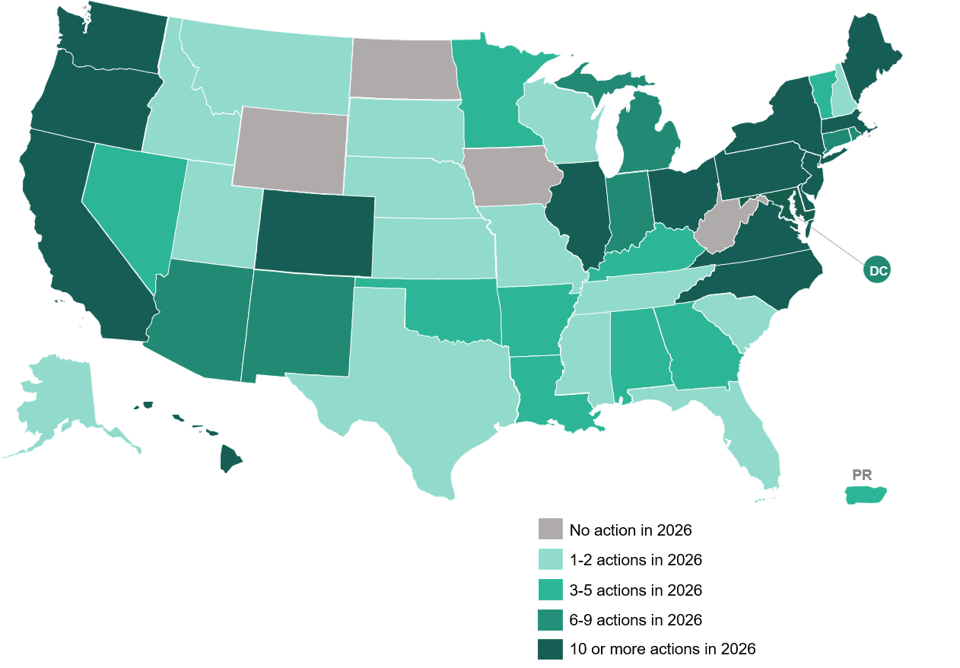
This initial report finds that 46 states, the District of Columbia, and Puerto Rico took a total of 362 actions to address energy affordability this year, as of June 2026. The greatest number of actions related to large load cost shift prevention (including large load tariffs), customer bill assistance programs, incentive programs for low- and moderate-income customers, and performance incentive mechanisms. Pennsylvania, New Jersey, California, and Maryland saw the most action, followed by Illinois, Maine, New York, and Virginia.
2026 Action on Energy Affordability (as of June 2026)
The report discusses three trends in energy affordability: (1) Governors across the country are wielding their influence and issuing executive orders to initiate studies and investigations into affordability; (2) Policymakers taking steps to mitigate cost shifts both from customer-facing programs that benefit low- and middle-income households and from new large load additions that require infrastructure investments; and (3) Legislatures, regulators, and Governors are all considering reforms to the traditional utility business model and profit-making models in order to incentivize utilities to provide enhanced public services.
“State policymakers and utilities can take immediate action to lower energy costs for customers,” said Nick Montoni, Senior Program Director at NCCETC. “Whether by improving utility efficiencies, increasing utility oversight, or providing direct payments or programs to customers, there is a range of options that can ease energy costs, without waiting years to bring new infrastructure online.”
The report notes the top five policy actions this year, as of June 2026 were:
- Maryland lawmakers enacting the omnibus Utility RELIEF Act;
- The Governor of New Jersey signing an executive order addressing electricity costs and utility business model reform;
- The New York State Legislature passing a budget bill including an affordability index and monitor;
- Indiana legislators enacting an energy affordability and performance-based ratemaking bill; and
- Virginia lawmakers passing a suite of bills tackling energy affordability issues.
“Affordability is at the center of nearly all energy policy discussions today,” noted Autumn Proudlove, Managing Director at NCCETC. “States can learn a lot from each other on ways to address this issue, from approaches to contain costs and mitigate future rate increases to mechanisms that specifically support energy-burdened customers and provide more immediate relief.”
ABOUT THE NC CLEAN ENERGY TECHNOLOGY CENTER
The NC Clean Energy Technology Center, as part of the College of Engineering at North Carolina State University, advances a sustainable energy economy by educating, demonstrating and providing support for clean energy technologies, practices and policies. It serves as a resource for innovative, sustainable energy technologies through technology demonstration, technical assistance, outreach and training. For more information about the Center, visit: http://www.nccleantech.
Media Contact: Shannon Helm, NCCETC, [email protected]