50 States of Power Decarbonization Q1 2026: Lawmakers Tackle Cost Allocation and Ratepayer Protections for Large Load Additions
Article sections
Raleigh, NC – (May 7, 2026) The NC Clean Energy Technology Center (NCCETC) released its Q1 2026 edition of the 50 States of Power Decarbonization. The quarterly series provides updates on state and utility actions pertaining to clean energy targets, emission reduction targets and carbon policies, generation planning and procurement rules, large load customers, integrated resource plans, and electric generation capacity changes (RFPs, green tariffs, power plant retirements, etc.).
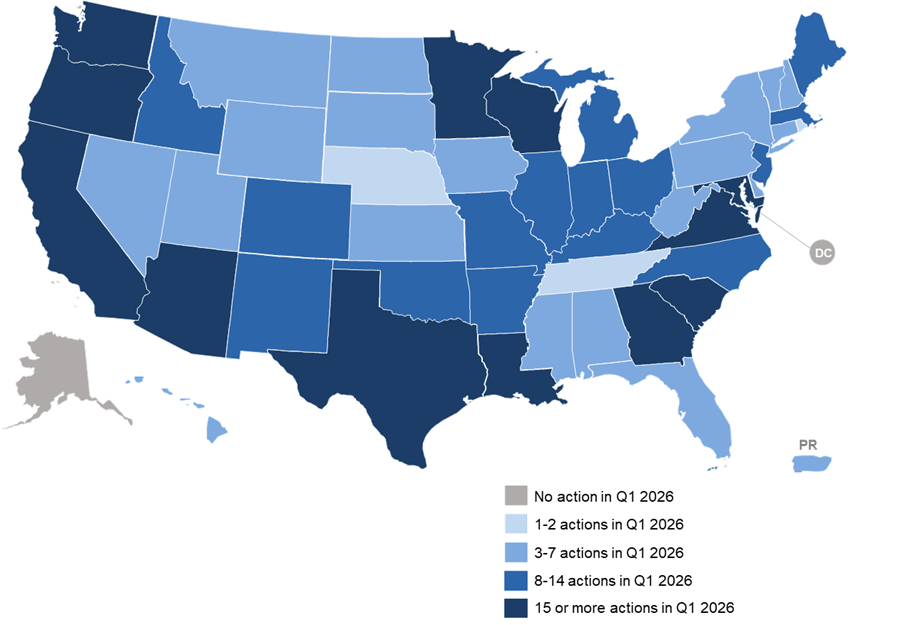
The Q1 2026 report finds that 49 states, as well as Puerto Rico, took a total of 509 actions related to electric power decarbonization and resource planning during the quarter (see figure below), in addition to more than 600 introduced bills that have not yet passed a legislative chamber.
The most active states this quarter were Virginia, Wisconsin, Maryland, and Arizona, followed by Oregon, Louisiana, Minnesota, and South Carolina. Among integrated resource plans recently filed or under review by regulators in Q1 2026, planned capacity additions totaled 58,276 for solar, 54,952 MW for natural gas, 30,297 MW for storage, and 22,358 MW for wind, while planned coal retirements totaled 30,967 MW.
Q1 2026 Action on Power Decarbonization and Resource Planning
The report discusses three trends in power decarbonization actions taken in Q1 2026: (1) lawmakers targeting large load cost allocation and ratepayer protections; (2) legislators establishing committees to research advanced nuclear; and (3) decision-makers addressing on-site generation for large load customers.
“State lawmakers considered more than 200 bills related to large customer energy use during the first quarter of the year,” observed Autumn Proudlove, Managing Director – Policy and Markets at NCCETC. “Many of these efforts focus on ensuring that other ratepayers do not bear the costs associated with large load additions, with legislation advancing on this topic in both red and blue states.”
The report notes the top five policy developments of Q1 2026 were:
- The Arizona Corporation Commission repealing the state’s renewable energy standard;
- Florida lawmakers requiring large load tariffs;
- A North Carolina task force releasing a report on large load growth;
- Virginia rejoining the Regional Greenhouse Gas Initiative; and
- El Paso Electric proposing large load tariffs based on load factors in New Mexico.
“Policymakers across the country appear almost unified in an effort to both bring on new capacity to fuel electricity-hungry data centers while allocating costs away from ratepayers,” noted Nick Montoni, Senior Program Director at NCCETC. “These actions provide a useful template for any state or jurisdiction looking to increase electricity supply for new large loads without placing a burden on the ratepayer base.”
View the 50 States of Power Decarbonization Q1 2026 Quarterly Report Executive Summary
View and Purchase the 50 States of Power Decarbonization 2025 Annual Review Q4 2025 Quarterly Report
ABOUT THE NC CLEAN ENERGY TECHNOLOGY CENTER
The NC Clean Energy Technology Center, as part of the College of Engineering at North Carolina State University, advances a sustainable energy economy by educating, demonstrating and providing support for clean energy technologies, practices and policies. It serves as a resource for innovative, sustainable energy technologies through technology demonstration, technical assistance, outreach and training. For more information about the Center, visit: http://www.nccleantech.
Media Contact: Shannon Helm, NCCETC, shannon_helm@ncsu.edu