
he 50 States of Grid Modernization Q3 2025: Utilities Pursue Grid Flexibility Through Virtual Power Plants and Demand Response Programs in Q3 2025
Article sections
Raleigh, NC – (October 22, 2025) The NC Clean Energy Technology Center (NCCETC) released its Q3 2025 edition of The 50 States of Grid Modernization. The quarterly series provides insights on state regulatory and legislative discussions and actions on grid modernization, utility business model and rate reforms, energy storage, microgrids, and demand response.
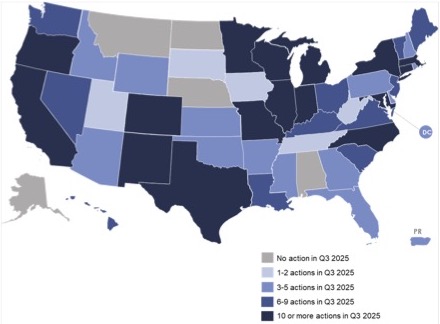
The report finds that 45 states, as well as the District of Columbia and Puerto Rico, took actions related to grid modernization during Q3 2025 (see figure below), with the greatest number of actions relating to energy storage deployment proposals (58), interconnection rules (32), energy storage deployment in utility integrated resource plans (31), smart grid technology deployment (29), performance-based demand response incentives (27), and overall utility business model reforms (27).
A total of 393 grid modernization actions were taken during Q3 2025, in addition to 190 introduced bills. California, Texas, Connecticut, and New York saw the most action during the quarter, followed by Colorado, Maryland, Massachusetts, and Michigan.
Q3 2025 Legislative and Regulatory Action on Grid Modernization
The report discusses three trends in grid modernization actions taken in Q3 2025: (1) utilities proposing new virtual power plant programs, (2) states and utilities considering enhancements to utility performance during outages, and (3) states considering demand response program innovations.
“As energy demand due to new load growth continues to rise, many utilities are turning to customer-sited resources for capacity,” noted Emily Apadula, Policy Analyst at NCCETC, “Virtual power plants, or VPPs, have quickly become a popular tool for utilities when it comes to capacity and grid flexibility.”
The report notes the top five policy developments of Q3 2025 were:
- Oregon lawmakers establishing rules for microgrids and performance-based regulation;
- Georgia regulators approving new storage programs from Georgia Power;
- The California Public Utilities Commission considering demand flexibility rates;
- Maryland investor-owned utilities submitting virtual power plant pilots; and
- Minnesota regulators adopting a framework for proactive grid upgrades.
“Policymakers in several states took important steps to expand the use of demand response, with policymakers looking for better coordination between different state, utility, and regional programs to achieve more meaningful results,” stated Brian Lips, Senior Project Manager at NCCETC.
View the 50 States of Grid Modernization Q3 2025 Quarterly Report Executive Summary
View and Purchase the 50 States of Grid Modernization Q3 2025 Quarterly Report
ABOUT THE NC CLEAN ENERGY TECHNOLOGY CENTER
The NC Clean Energy Technology Center, as part of the College of Engineering at North Carolina State University, advances a sustainable energy economy by educating, demonstrating and providing support for clean energy technologies, practices and policies. It serves as a resource for innovative, sustainable energy technologies through technology demonstration, technical assistance, outreach and training. For more information about the Center, visit: http://www.nccleantech.
Media Contact: Shannon Helm, NCCETC, shannon_helm@ncsu.edu