Rebuilding Western North Carolina with Microgrids
By: Isaac Panzarella, Associate Director – Technical Services
Just over a year ago, Hurricane Helene wrought devastation on many Western North Carolina communities, and most people felt the impacts of power, water and communication outages for days and even weeks afterwards. The day after the storm, the Footprint project dispatched a team from New Orleans and got to work installing mobile solar PV and battery storage microgrids at key locations; fire houses, community centers, nonprofit centers nursing homes, libraries, mobile home parks and more. Local solar installers and volunteers joined the effort that for many weeks provided critical power to support aid distribution, emergency responders and medical needs.
Now, work is starting on a Clean Energy Microgrid project that will install more than 25 permanent microgrids and two resilience hubs in areas of North Carolina affected by the disaster. The project is led by Land of Sky Regional Council, Footprint and the North Carolina Sustainable Energy Association, and supported by a combination of private funding and donations, and a $5 million grant from the NC State Energy Office. The resilience hubs, called “beehives” will act as a base operations, and feature a series of mobile power trailers, “bees,” that can be quickly dispatched to respond to communities impacted by future disasters.
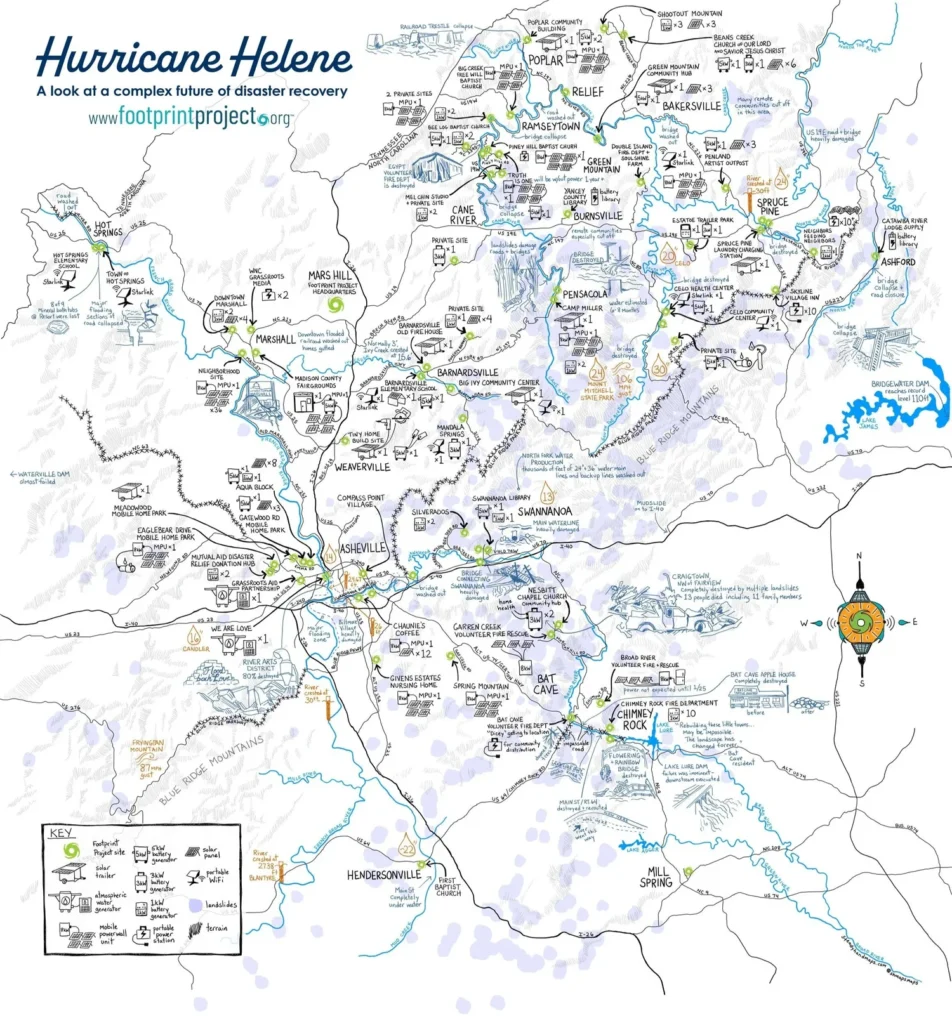
At Footprint Project’s website (https://www.footprintproject.
The City of Asheville is also looking to add a battery storage unit to an existing solar PV array at the Broadway Public Safety Station, which serves as a fire station and the city’s emergency operations center. A team, including engineers from TRC and the NC Clean Energy Technology Center, is helping the City to analyze and develop a plan for the proposed microgrid project.

City of Asheville’s Broadway Public Safety Station (source: ADW Architects)
Microgrids like the ones that the North Carolina is deploying, can provide reliable and resilient clean energy for critical facilities, are not a new technology, but are underutilized. The Department of Energy developed this definition in 2010: A microgrid is a group of interconnected loads and distributed energy resources within clearly defined electrical boundaries that acts as a single controllable entity with respect to the grid. A microgrid can operate in either grid-connected or in island mode, including entirely off-grid applications. (https://www.energy.gov/sites/
After other significant natural disasters, including Hurricane Katrina (2005), Superstorm Sandy (2012), Hurricane Maria (2015) and Hurricane Florence (2018), public leaders and utilities have discussed ways to rebuild the utility grid to be stronger and more resilient, but only a few microgrids have been built as a result. Superstorm Sandy is one case where state and local officials and the energy sector established various funding sources for microgrids, including green banks in Connecticut and New Jersey and grant programs in New York.
The reasons for relatively few microgrids being built are complex, but are characterized by a higher cost than larger scale solar and battery projects that make them difficult to justify on a traditional direct economic cost-benefit basis. Still, a value can be placed on the indirect benefits of microgrids to governments, citizens and businesses that rely on them in a disaster. Also, microgrids can be a solution to persistent power reliability issues, such as in the case of the Hot Springs Microgrid in Madison County, North Carolina. This microgrid provided Hot Springs with power for eight days following Hurricane Helene, which washed away a large substation and damaged the wires feeding it.
The U.S. Department of Energy has kept a microgrid database for the past five years, and recently released a new version. This database catalogs over 1,200 microgrids in the U.S., ranging in size from 2 kilowatts to 288 megawatts. (https://www.onsite-energy-
It’s encouraging to see a big emphasis on rebuilding Western North Carolina with solar PV and battery microgrids. Not only is this rebuilding better, it is supporting a solar energy industry that employs many people to meet the state’s renewable energy goals. As North Carolina’s economy and demand for power grows it’s also important to include microgrids as a way to add capacity to the grid. Imagine industrial parks with microgrids that have flexible capacity to support the grid, while also providing backup energy to local grids during outages. Or data centers with microgrids with generation that satisfies the new demand, supports the grid, and that can also provide critical power during disasters.